Inscriptions
Descriptif
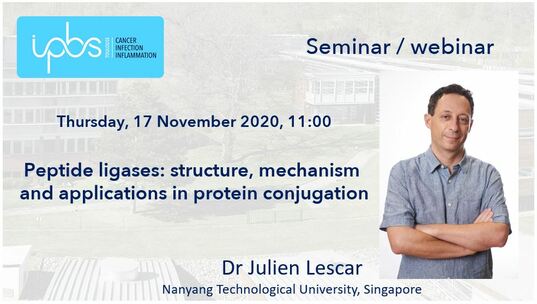
Julien Lescar
Nanyang Technological University, Singapore
Peptide ligases: structure, mechanism and applications in protein conjugation
While proteases that break proteins into pieces are quite common, enzymes that glue proteins back together have been more difficult to identify.
A class of enzymes which stitch proteins together are called “peptide asparagine ligases”. Peptide asparagine ligases are of great interest for many biotechnological and biomedical applications, such as protein labeling, to image and track proteins, or for specifically attaching toxic payloads to antibodies that recognize tumor markers, allowing the production of homogeneous antibody-drug conjugates for cancer immunotherapy.
Using transcriptomics, site-directed mutagenesis, catalytic and structural analysis of enzymes from plants belonging to the Violaceae family, we were able to define two stretches of sequences responsible for the observed range of protease vs ligase activities1. We called these sequences “Ligase Activity Determinants” or “LAD1 and LAD2” for short. LAD1 overlaps with the “gate-keeper residue” that we described previously. 2 LAD1 was found to regulate the velocity of the enzymatic reaction. Remarkably, by targeting the LAD2 region, we were able to convert a protease into a very efficient peptide ligase1,3. One major impact of this work is that it opens up possibilities for identifying novel interesting peptide ligases by simply searching sequence databases and also to engineer new peptide ligases with tailored specificities. In conclusion, we have succeeded in engineering a series of very efficient recombinant peptide ligases, some having orthogonal specificities, that can now be used for specific protein labeling and conjugation for various biotechnology and biomedical applications.
Selected publications
- Hemu X., El Sahili A., Hu S., Wong K., Zhang X., Serra A., Wong Y.H., Chen Y., Goh B.C., Darwis D.A., Chen M.W., Sze S.K., Liu C-F, Wu B., Lescar J*, Tam J.P*. (2019) Structural determinants for peptide bond formation by asparaginyl ligases. Proc. Natl. Acad. Sci. USA 116(24):11737-11746
- Yang R, Wong YH, Nguyen GKT, Tam JP, Lescar J*, Wu B* (2017) Engineering a catalytically efficient recombinant protein ligase. J. Am. Chem. Soc. 139(15) 5351-5358
- X. Hemu, A. El Sahili, S. Hu, X. Zhang, A. Serra, B.C. Goh, D.A. Darwis, Chen M.W., Sze S.K., Liu C-F, Lescar J*, Tam J.P*. (2020) Turning an asparaginyl endopeptidase into a peptide ligase. ACS Catalysis 10 (15), 8825-8834
Other references
- Gharbi-Ayachi A, Santhanakrishnan S, Wong YH, Chan KWK, Tan ST, Bates RW, Vasudevan SG, El Sahili A* & Lescar J.* J. Virol. (2020) Non-Nucleoside Inhibitors of Zika virus RNA-dependent RNA polymerase. JVI.00794-20
- Pan J.*, Qian X., Lattmann S., El Sahili A., Yeo TH, Huan J, Cressey T, Ludeke B., Noton S., Kalocsay M., Fearns R.* & Lescar J* (2020) Structure of the human metapneumovirus polymerase phosphoprotein complex. Nature 577(7789) 275-279
- El Sahili A, Soh TS, Schiltz J, Gharbi-Ayachi A, Seh CC, Shi PY, Lim SP* & Lescar J.* (2019) NS5 from Dengue virus serotype 2 can adopt a conformation analogous to its ZIKV and JEV homologues. J. Virol. ;94(1):e01294-19
- Liu C, Liew CW, Pho WH, Manimekalai S., Rajan S., Liang ZX, Gruber G, Rice S & Lescar J* (2018) The crystal structure of the PAS-GGDEF-EAL region of RbdA (PA0861) from Pseudomonas aeruginosa suggests a mechanism for the regulation of biofilm dispersal. J. Bacteriol. 200(3):e00515-17
- Wong Y-H, Goh BC, Lim SY, Lim APC, Dedon PC, Hanson BJ, MacAry PA & Lescar J* (2017) Structural mimicry of the dengue virus envelope glycoprotein revealed by the crystallographic study of an idiotype-anti-idiotype complex. J. Virol. 91(17) e00406-17
Laisser un commentaire
Événement
Seminar Dr. Julien Lescar
FRANCE
Contact organisateur
Institut de pharmacologie et de Biologie structurale
Communication IPBS
Adresse : 205 route de Narbonne
31077 Toulouse Cedex4
FRANCE
Téléphone : 0601265259
Visuel